


Today we are going to take a look at an incredibly powerful way to create meaningful homework material based on vocabulary that crops up in lessons and is noted on blackboards/whiteboards/IWBS.
I am referring to teacher interventions resulting from live reformulations (providing a correct or a more accurate version of the students’ utterances), extensions (offering alternative ways of expressing the same idea), or answering students’ questions about vocabulary. Sometimes the most interesting and relevant vocabulary emerges from banter, comments and side-tracks.
It is worth noting that a substantial amount of these lexical items gets written down in IWB-equipped classrooms, as there is always room for more annotations when the teacher runs out of space by displaying a new blank page. The resulting file can be saved for future reference. Personally, I like to take a photo of the different screen pages at the end of the lesson to later devise materials or activities for recycling and spaced repetition. I also keep a notebook for each class I teach where I record these lexical items.
In addition to routinely revisiting this vocabulary in the classroom setting by asking students to engage with it in different ways (e.g., guessing games, thinking of conversation questions featuring these words, arranging words into different lexical sets, or doing micro writing activities that involve using these items), we can now take advantage of Gen.AI to instantly and effortlessly create homework with it.
Let’s take a look at some board annotations from an Upper-Intermediate class. Students were discussing the topic of sleep, first in small groups and then in plenary mode. While they were working in small groups, I was eavesdropping, assisting them with language, and writing my reformulations and suggestions on the board. Before the whole-class speaking session, we reviewed most of these words and their meanings, and explored how they could be used in connection with what the students had been trying to express earlier. I will now select a few lexical items relevant to the topic that I find useful for students to know, add to their mental lexicon and use. These items will also be added to my class notebook to design activities aligned with them.
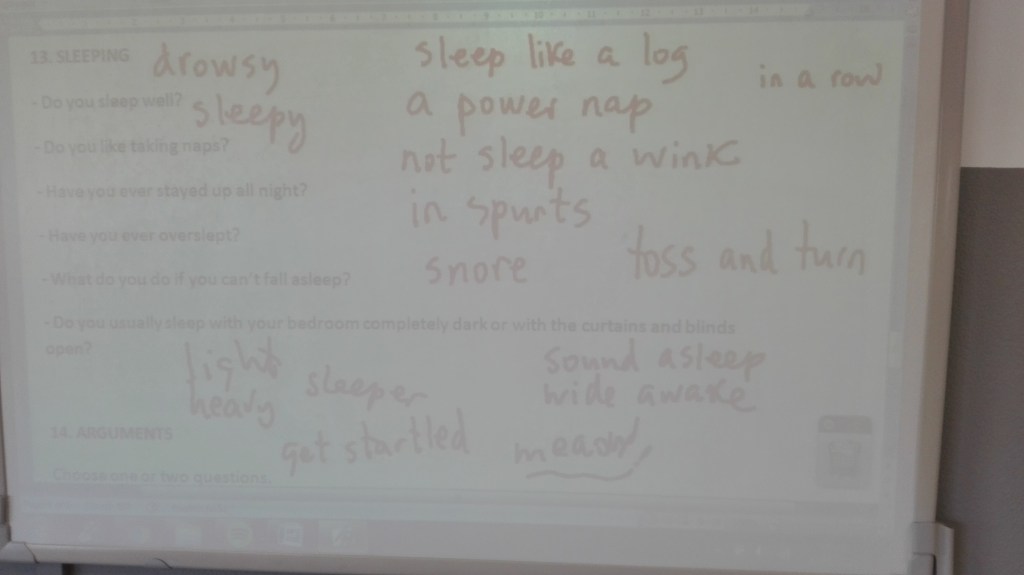
– drowsy
– sleepy
– sleep like a log
– a power nap
– not sleep a wink
– in spurts
– snore
– toss and turn
– sound asleep
– wide awake
– a light/a heavy sleeper
– to get startled
Now I would take a couple of minutes to access Claude and write the following prompt:
I am an English teacher, and I teach an Upper-Intermediate level English class. Generate a handout for my students using the lexical items I will provide at the end of the prompt. First, create two example sentences for each item so that students can clearly understand their meaning at their language level. Please type the key items in bold. Then, create a fill-in-the-gaps exercise using these items, with 20 different sentences where those items are missing and are replaced by gaps. Next, provide the answers for the fill-in-the-gaps exercise (words listed above).
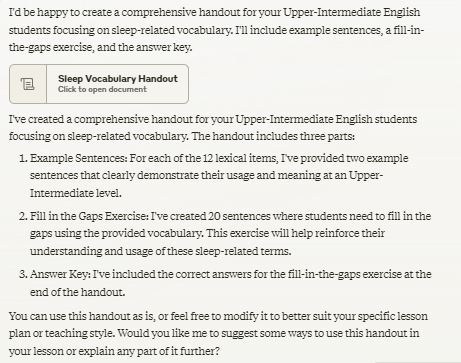
Sleep Vocabulary Handout
Example Sentences
- Drowsy
- The warm room and soft music made everyone feel drowsy during the lecture.
- After taking his allergy medicine, John felt drowsy and decided not to drive.
- Sleepy
- After staying up late to finish her project, Sarah was very sleepy the next morning.
- The children grew sleepy as they listened to their grandmother read a bedtime story.
- Sleep like a log
- After hiking all day, I slept like a log and didn’t hear the thunderstorm during the night.
- My brother always sleeps like a log when he visits our quiet countryside home.
- A power nap
- Many office workers take a power nap during their lunch break to boost afternoon productivity.
- Athletes often use a power nap to recharge quickly between training sessions.
- Not sleep a wink
- Due to her anxiety about the job interview, Lisa didn’t sleep a wink the night before.
- With the noisy construction next door, I didn’t sleep a wink all night.
- In spurts
- The newborn baby slept in spurts, waking up every few hours to feed.
- My inspiration for writing comes in spurts – sometimes I write for hours, other times I can’t think of anything.
- Snore
- My roommate tends to snore loudly, so I always wear earplugs to bed.
- Jack was embarrassed to learn that he snores during long flights.
- Toss and turn
- I tossed and turned all night, worrying about my upcoming presentation.
- The uncomfortable hotel bed made her toss and turn until sunrise.
- Sound asleep
- By the time I checked on the children, they were all sound asleep.
- Don’t make too much noise; your father is sound asleep in the next room.
- Wide awake
- Despite the late hour, I was still wide awake after watching that thrilling movie.
- The strong coffee kept me wide awake throughout the night shift.
- A light sleeper / a heavy sleeper
- I’m a light sleeper, so even the slightest noise wakes me up.
- My brother is a heavy sleeper and can sleep through almost anything.
- To get startled
- The sudden loud noise startled me, making me jump out of my chair.
- Be careful not to startle the deer when you’re walking in the forest.
Fill in the Gaps Exercise
Complete the sentences with the appropriate words or phrases from the list:
drowsy, sleepy, sleep like a log, a power nap, not sleep a wink, in spurts, snore, toss and turn, sound asleep, wide awake, a light sleeper, a heavy sleeper, startled
- After taking his medication, Tom felt __________ and decided not to drive.
- Despite being tired, Sarah couldn’t __________ because of her upcoming exam.
- John is __________, so he often wakes up when he hears any unusual sounds in the house.
- The student tried to stay __________ during the boring lecture, but he kept yawning.
- My grandfather tends to __________ loudly, which sometimes disturbs my grandmother’s sleep.
- Many professionals take __________ during their lunch break to boost productivity.
- The sudden thunderclap __________ the cat, causing it to run and hide under the bed.
- I __________ all night due to the stress of my job interview the next day.
- After the long hike, we were so exhausted that we __________ and didn’t wake up until noon.
- The baby sleeps __________, waking up every few hours for feeding.
- By the time the movie ended at midnight, I was surprisingly still __________.
- He’s such __________ that he didn’t even notice when the fire alarm went off briefly during the night.
- I __________ last night because of the neighbor’s loud party next door.
- When I checked on my daughter at midnight, she was __________ with her favorite teddy bear.
- The old mattress made me __________ all night, and I woke up with a sore back.
- After his __________, Mark felt energized and ready to tackle the rest of his workday.
- The ghost story __________ me so much that I couldn’t fall asleep for hours.
- My roommate claims he doesn’t __________, but I can hear him from across the hall every night.
- The warm sunshine and gentle breeze made everyone feel __________ during the picnic.
- The irregular sleep schedule of a new parent often means sleeping __________ whenever the baby allows.
Answer Key
- drowsy
- sleep a wink
- a light sleeper
- wide awake
- snore
- a power nap
- startled
- tossed and turned
- slept like a log
- in spurts
- wide awake
- a heavy sleeper
- didn’t sleep a wink
- sound asleep
- toss and turn
- power nap
- startled
- snore
- drowsy/sleepy
- in spurts
Now I can open the document and copy or download it. I find it more practical to just copy and paste into a Word document that can be emailed, uploaded to a learning platform, or (my favourite option) pasted into a Google Doc that students have already access to. This way, there’s nothing else to do after copying and pasting. If you have already typed and saved the prompt in the Gen.AI tool, all there is to do is retrieve it, copy and paste it, and replace the target expressions as needed.
Of course, there are many other types of activities we could create and assign as homework. One of my favorites is asking Gen.AI to generate example sentences and then translate them into the students’ native language. Students would then read the translated sentences and try to retrieve the selected language items.

