


A dice-roll grid is a table with 6 rows and 6 columns and a total of 36 cells representing the outcome of a roll of two six-sided dice. The 6 rows and 6 columns correspond to each die’s roll. Dice-roll grids are often used in board games and speaking activities in the language classroom. Students roll a die twice to get the coordinates for the task. Gen. AI can create these grids in a split second, ready to be printed or copied and pasted into a digital document for later classroom use.
We can create a 6×6 grid with conversations questions. This could be useful for introducing a speaking topic or a unit from the coursebook to pave the way for more specific tasks at a later stage. Alternatively, we can use it to wrap up a lesson.
Prompt: Create a 6 by 6 dice-roll grid with conversation questions for the English as a Second Language classroom. The topic is tourism and the language level is [language level].
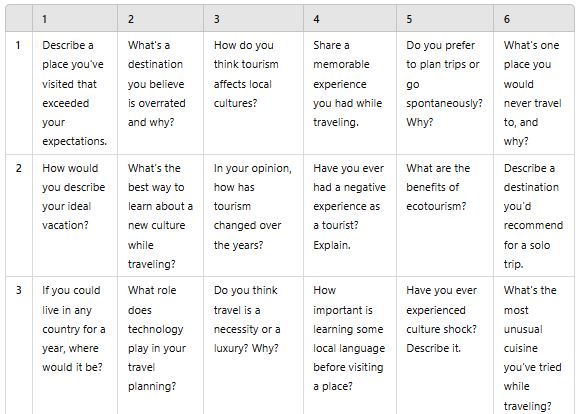
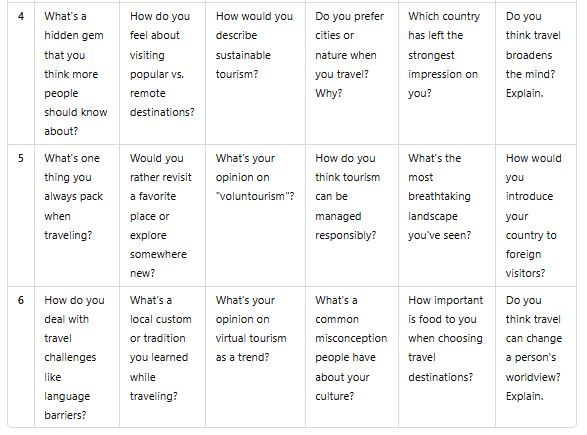
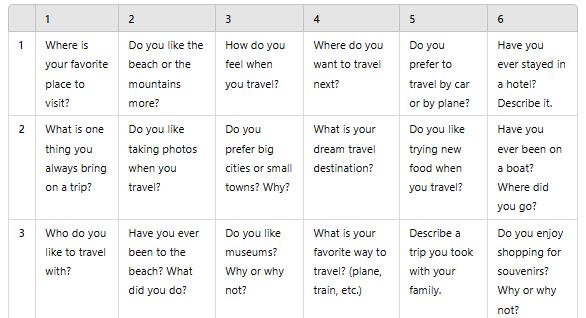
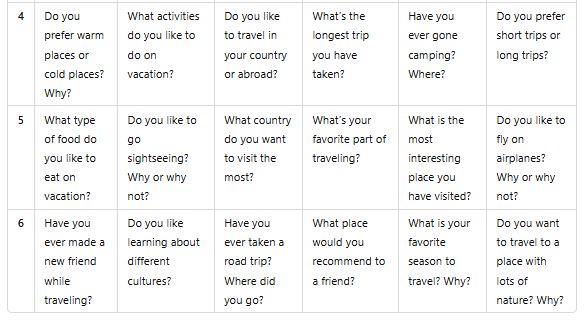
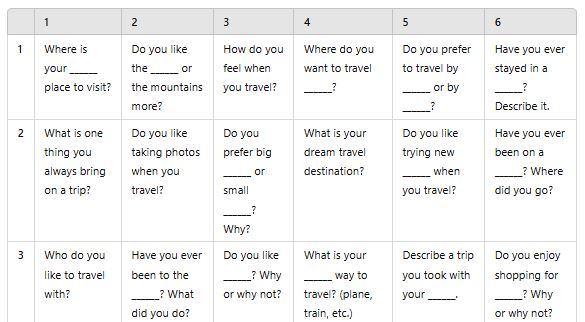
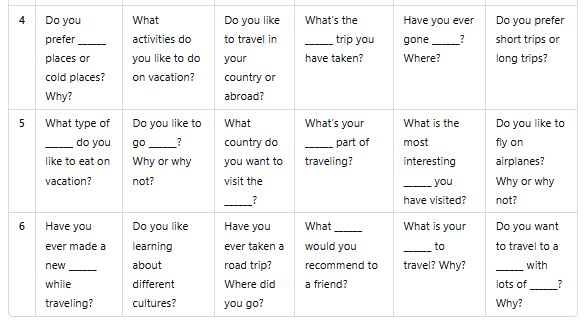
It is important to specify the language level. See the two grids below. The first one shows a conversation grid for the Advanced level, while the second one is designed for the Elementary level, as stated in the prompt.
Travelling. Advanced.
Travelling. Elementary.
I think ChatGPt did a fine job with the nature of the questions and the expected outcomes from learners. If we are not happy with some of the questions, we can always write a new prompt asking ChatGPT to generate the same grid again, but this time removing specific questions from the given coordinates and replacing them with different ones.
And here’s a really interesting tweak: once the grid is created, we can write a new prompt asking ChatGPT to generate the same grid again, but this time removing the words we will be typing. So I just did that and now some of the questions are more open-ended, requiring students to get more creative and make choices based on word combinations or grammar use.
Prompt: create the second grid again but this time remove the following words and replace them with dotted lines: favorite, beach, next, car, plane, hotel, cities, towns, food, boat, museums, family, souvenirs, warm, longest, camping, food, sightseeing, most, place, friend, season, nature.
This tweak transforms the activity and encourages students to think critically and fill in the blanks based on their language knowledge and imagination. It’s a simple way to make the exercise more dynamic and challenging!
Obviously, we could always think of our own questions and type them. It doesn’t have to be a total of 36 questions. We can provide just a handful of them and ask ChatGPT to generate the rest.
Personally, I like a 5×5 variation of these grids and ask students to stand up in two circles (for large classes we may have to split the class into different groups). Half the students form a circle facing outward, while the other half form a circle facing inward, so students are paired up. Then in a rock-paper-scissors style manner, each student shows a number with their fingers from 1 to 5. The two numbers are added to determine the corresponding coordinate in the grid. The students then discuss the question from that coordinate for a short time. When time is up, students in the outer circle move one spot to the left to pair up with a different student for a new question, and so on.
We would be displaying this conversation grid on the whiteboard/IWB/digital panel at the front of the classroom for everyone to see.

