

Have you ever tried having your students keep journals in the language classroom? This can be done using personal notebooks or digital tools, allowing students to record their thoughts and ideas. Journals are very useful as language learning tools because they help build the habit of writing regularly. Good habits learn the foundation for consistent progress.
Students could keep a journal, write a few lines on a regular basis, and then type or copy and paste the content into a Gen.AI tool to check for mistakes or even produce an improved version of it.
My personal Gen.AI-powered variation of journals deviates from the very essence of journals -writing down your inner thoughts. However, it can have a transformative impact from a language-learning standpoint as well.
Here is the idea: students could reflect on their plans for the day, daily activities, accomplishments, goals, aspirations, or anything else that comes to mind. They would use a Gen.AI tool to write down their thoughts for the day in their L1. Next, they would ask the tool to translate the resulting text into their target language (L2).
My recommendation now is for them to grab a pen and a notebook to use as a journal for this purpose and write down that text in their notebook, taking note of interesting or useful words, language chunks or grammar structures they would like to actively learn. In other words, they should focus on items they would like to eventually produce effortlessly in L2. They could highlight or underline these items. There’s no need to translate, as they are already familiar with the meaning since they previously wrote those thoughts in their L1.
I will be using Gemini this time, and I will be writing a hypothetical journal entry from a hypothetical student in Spain.
Hoy me levanté con mucho sueño porque no pude dormir bien. Me despertó el ruido de la tormenta anoche y no hubo manera de pegar ojo hasta una hora más tarde. No sé si tendré ganas de ir al gimnasio por la tarde después de trabajar. Me parece a mí que no. Contando los días para las vacaciones de Navidad. ¡Vaya ganas de que lleguen! Lo malo que está todo tan caro, que este año no toca irse a las Canarias.
The prompt is quite straightforward: please translate this text (text above) into English. The style should be informal, reflecting the tone of the original.
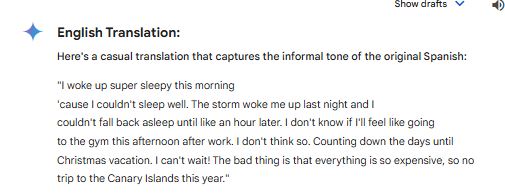
“I woke up super sleepy this morning ’cause I couldn’t sleep well. The storm woke me up last night and I couldn’t fall back asleep until like an hour later. I don’t know if I’ll feel like going to the gym this afternoon after work. I don’t think so. Counting down the days until Christmas vacation. I can’t wait! The bad thing is that everything is so expensive, so no trip to the Canary Islands this year.”
My personal observations.
1. The tone and style do reflect the original.
2. Students can actually listen to the generated text by clicking on the audio icon in the top-right corner above the text.
3. There is always something to learn for everyone, regardless of language level. At the Advanced level, students would actually master all the language that we can see here. It would already be part of their productive skills. However, depending on the nature of their L1 text, and especially so if they are curious about how to say something specific they may not know in L2 and decide to include the L1 counterpart, they might discover something new to learn.
At the Intermediate level, students might notice how the connector ‘because’ gets shortened to ’cause’ in informal speech, and then they can check the pronunciation by clicking on the audio icon. Other relevant items for this language level may include ‘like an hour later’, ‘feel like going to the gym’, ‘I don’t think so’ or ‘can’t wait’.
For Elementary learners, the resulting text obviously goes beyond their current language level. However, since it’s content they’ve personally produced, there is no need for further translation. It’s already in L1! They can simply highlight one or two expressions they want to incorporate into their repertoire and leave it at that. The process is simple: they can listen to the text using the text-to-speech feature, notice pronunciation, write it down in their journal, and highlight one or two items to learn. One or two items at a time -many times- with constant reviewing is a lot of language to learn.
 AI in ELT