

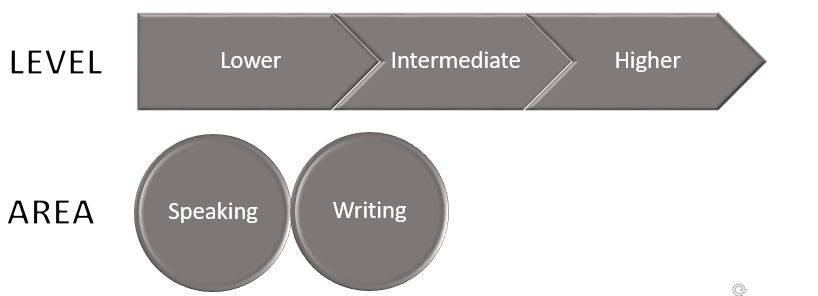
Today I am going to show a couple of examples of how ChatGPT can generate rubrics for assessing students’ work and performance. A rubric is an assessment tool that outlines specific criteria for grading or evaluating student work in specific areas such as grammar accuracy or use of vocabulary. It includes a scoring scale and descriptors that define levels of performance. Rubrics provide students with feedback on strengths and areas for improvement, making grading more objective and transparent.
In the context of ESL teaching, rubrics are commonly used for individual or group in-class presentations, projects, speaking and writings assignments, standardized speaking and writing tests or portfolio assessments.
Holistic rubrics assess a student’s performance based on a general impression. They do not break down the evaluation into specific components. While they are simpler and quicker to use, they provide less specific feedback.
Analytic rubrics break down the assessment into specific criteria and provide separate scores for each component. They are more detailed and time-consuming but help students understand precisely where they need to improve. Gen.AI is particularly useful for this type of rubric, as it can save us precious time.
Here is a useful prompt for an analytic rubric for a speaking test. Prompt: Take on the role of an experienced teacher for Escuelas Oficiales de Idiomas in Spain. I want you to create a well-crafted analytic rubric in the form of a table to assess my students’ speaking performance. The language levels are Intermediate to Advanced. You must use student-friendly language. The rubric should contain three sections: scoring and scale, criteria and descriptors. The rubric should evaluate the following areas: content and task achievement, organization and coherence, grammar accuracy, range of vocabulary, and pronunciation and fluency. The top row of the table should indicate the scoring scale and points. The first column on the left side of the table should outline the criteria. The descriptors for each component and score should be placed within the appropriate scoring scale and points column and criteria row. The highest possible score is 20 points.

Now, if we want to copy and paste this table into a Word document without losing any formatting or spending ages tweaking it, we can copy and paste the table from ChatGPT into Excel and then copy and paste into Word using the ‘Keep Source Formatting’ option, which is what I have just done.
| Criteria | Excellent (5 points) | Good (4 points) | Satisfactory (3 points) | Needs Improvement (2 points) | Insufficient (1 point) |
| Content & Task Achievement | Fully addresses the task with relevant, detailed ideas. Demonstrates clear understanding of the topic. | Covers the task well with relevant ideas and minor gaps in detail. Shows good understanding. | Addresses the task but ideas may lack some detail or relevance. Understanding is adequate. | Partially addresses the task. Ideas are limited, unclear, or off-topic at times. | Does not address the task. Ideas are minimal, irrelevant, or missing. |
| Organization & Coherence | Ideas are well-organized with clear, smooth transitions. The monologue is easy to follow. | Ideas are mostly organized. Transitions are effective, with minor lapses. Generally easy to follow. | Organization is basic but mostly clear. Some ideas may be disconnected or unclear. | Lacks clear organization. Ideas are difficult to follow and may seem random. | No organization is evident. The monologue is confusing and lacks flow. |
| Grammar Accuracy | Consistently uses a range of structures with minimal errors. Errors are rare and do not affect understanding. | Uses a variety of structures with minor errors. Mistakes do not interfere with communication. | Uses mostly basic structures with some errors that may cause confusion. | Limited use of grammar structures. Frequent errors often make understanding difficult. | Minimal use of correct grammar. Many errors that severely hinder communication. |
| Range of Vocabulary | Wide range of vocabulary used effectively and naturally. Uses level-appropriate expressions confidently. | Good range of vocabulary with minor repetition. Uses some complex words and expressions. | Adequate vocabulary range. Some repetition and limited use of complex expressions. | Limited vocabulary range. Often repeats basic words. Struggles with more advanced language. | Very limited vocabulary. Frequent repetition and incorrect use of words. |
| Pronunciation & Fluency | Clear pronunciation with natural intonation. Speaks fluently with minimal hesitation. | Generally clear pronunciation. Speech is mostly fluent, with occasional pauses. | Pronunciation is mostly understandable. Fluency is affected by frequent pauses or hesitations. | Pronunciation issues make some parts hard to understand. Speech is slow and lacks flow. | Pronunciation is unclear. Hesitations and breakdowns make the monologue very difficult to follow. |
Scoring Guide:
- 20-18 points: Excellent performance (Strong command of speaking skills at this level).
- 17-15 points: Good performance (Consistently clear and effective speaking).
- 14-11 points: Satisfactory performance (Adequate but with noticeable areas for improvement).
- 10-6 points: Needs Improvement (Limited performance, below expected level).
- 5-0 points: Insufficient performance (Does not meet level standards).
This rubric provides detailed, student-friendly descriptors for each performance level, helping students understand their strengths and areas to work on. It aligns well with the expectations for Intermediate to Advanced levels and encourages clear, focused feedback.
Notice that there is a critical mistake here. The highest possible score is 25, not 20 as shown in the scoring guide. This can easily be solved by changing the scoring scale from ‘5 to 1’ to ‘4 to 0’. Then, if we feel that other changes need to be made, we can fine-tune the prompt to meet our needs or simply make the adjustments manually. I don’t know if you will agree with me –specially the many teachers at Escuelas Oficiales de Idiomas in Spain who read this blog- but the rubric above would be a very adequate tool for assessing students at that language level. Personally speaking again, I find it just as effective and even more practical than the standardized rubric I have to use.
Let’s have a go with a holistic rubric this time. Let’s imagine that our students give in-class presentations regularly, and after each presentation, we want to provide feedback -whether this is done privately or in front of their peers- using a less detailed rubric that gives them a general idea of how things went. This is a possible prompt:
Take on the role of an experienced teacher at Escuelas Oficiales de Idiomas in Spain. I want you to create a holistic rubric to assess my students’ speaking performance. Each student will give a 5-minute in-class presentation on a topic of their choice. The language levels are Intermediate to Advanced. You must use student-friendly language so that the students can easily understand the descriptors. The rubric should evaluate the following areas: content and task achievement, organization and coherence, grammar accuracy, range of vocabulary, and pronunciation and fluency.
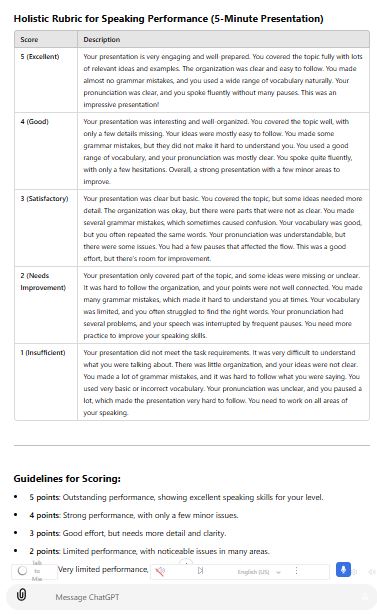
| Score | Description |
| 5 (Excellent) | Your presentation is very engaging and well-prepared. You covered the topic fully with lots of relevant ideas and examples. The organization was clear and easy to follow. You made almost no grammar mistakes, and you used a wide range of vocabulary naturally. Your pronunciation was clear, and you spoke fluently without many pauses. This was an impressive presentation! |
| 4 (Good) | Your presentation was interesting and well-organized. You covered the topic well, with only a few details missing. Your ideas were mostly easy to follow. You made some grammar mistakes, but they did not make it hard to understand you. You used a good range of vocabulary, and your pronunciation was mostly clear. You spoke quite fluently, with only a few hesitations. Overall, a strong presentation with a few minor areas to improve. |
| 3 (Satisfactory) | Your presentation was clear but basic. You covered the topic, but some ideas needed more detail. The organization was okay, but there were parts that were not as clear. You made several grammar mistakes, which sometimes caused confusion. Your vocabulary was good, but you often repeated the same words. Your pronunciation was understandable, but there were some issues. You had a few pauses that affected the flow. This was a good effort, but there’s room for improvement. |
| 2 (Needs Improvement) | Your presentation only covered part of the topic, and some ideas were missing or unclear. It was hard to follow the organization, and your points were not well connected. You made many grammar mistakes, which made it hard to understand you at times. Your vocabulary was limited, and you often struggled to find the right words. Your pronunciation had several problems, and your speech was interrupted by frequent pauses. You need more practice to improve your speaking skills. |
| 1 (Insufficient) | Your presentation did not meet the task requirements. It was very difficult to understand what you were talking about. There was little organization, and your ideas were not clear. You made a lot of grammar mistakes, and it was hard to follow what you were saying. You used very basic or incorrect vocabulary. Your pronunciation was unclear, and you paused a lot, which made the presentation very hard to follow. You need to work on all areas of your speaking. |
Guidelines for Scoring:
- 5 points: Outstanding performance, showing excellent speaking skills for your level.
- 4 points: Strong performance, with only a few minor issues.
- 3 points: Good effort, but needs more detail and clarity.
- 2 points: Limited performance, with noticeable issues in many areas.
- 1 point: Very limited performance, with serious problems in all areas.
This rubric is designed to give clear, easy-to-understand feedback to students, helping them see their strengths and what they need to work on to improve their speaking skills.
A far less detailed assessment, but arguably more useful for this type of task. Notice how the language is adapted, as instructed in the prompt.
Some final considerations:
- We must provide an assigment description in the prompt. Is it a rubric for teamwork, individual work, a presentation, a speaking test, a narrative essay, or a portfolio?
- We must also include the criteria we think are important. What are the primary goals? What are your school’s or school district’s requirements?
- The generated rubric may not be perfect, but it is definitely a good starting point. Based on what we see, we can craft a second prompt or make those changes manually.
 AI in ELT