


Today we are going to take a look at a highly productive activity students can do on their own to challenge themselves and play with the language. The idea is to type a sentence into a Gen.AI took –I’ll be using ChatGPT- or ask Gen.AI to generate a random sentence, and then try to replace words in it without altering its meaning.
This gives students practice in both vocabulary and grammar, as the new words may require different grammar patterns. It also helps consolidate words and patterns they are familiar with. The more choices we make about words and the longer those words hover in our minds, the greater the impact on retention and use.
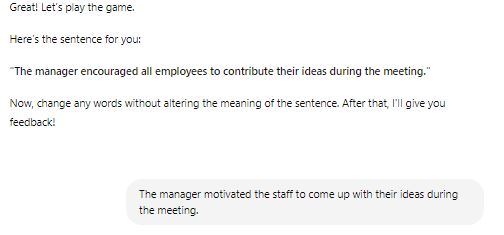
Here’s the prompt: We are going to play a game. I am an Upper-Intermediate learner of English. Write a sentence in English that is suitable for my English level, and it’s my job to change any words from it without altering the meaning of the sentence. Then, you will give me feedback, let me know if I did a good job, tell me how you would have done it, and then write a new sentence for me.
Great! Let’s play the game.
Here’s the sentence for you:
“The manager encouraged all employees to contribute their ideas during the meeting.”
Now, change any words without altering the meaning of the sentence. After that, I’ll give you feedback!
You said:
The manager motivated the staff to come up with their ideas during the meeting.
ChatGPT said:
ChatGPT
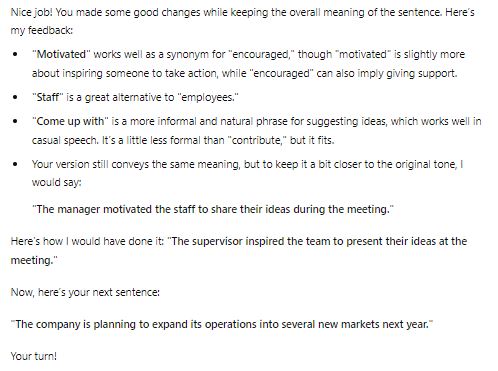
Nice job! You made some good changes while keeping the overall meaning of the sentence. Here’s my feedback:
- “Motivated” works well as a synonym for “encouraged,” though “motivated” is slightly more about inspiring someone to take action, while “encouraged” can also imply giving support.
- “Staff” is a great alternative to “employees.”
- “Come up with” is a more informal and natural phrase for suggesting ideas, which works well in casual speech. It’s a little less formal than “contribute,” but it fits.
- Your version still conveys the same meaning, but to keep it a bit closer to the original tone, I would say:
“The manager motivated the staff to share their ideas during the meeting.”
Here’s how I would have done it: “The supervisor inspired the team to present their ideas at the meeting.”
Now, here’s your next sentence:
“The company is planning to expand its operations into several new markets next year.”
Your turn!
I find that the feedback given is very accurate and useful, as context and register are taken into consideration, in addition to semantic and grammatical accuracy being checked. I am going to test how this would work out for low levels while making deliberate mistakes in my version with different words. Prompt: Let’s do it again, but this time let’s pretend I am an elementary student of English.


Alright! Let’s adjust the difficulty for an elementary-level English student. Here’s your first sentence:
“The boy eats an apple every morning.”
Now, you change some words without changing the meaning. I’ll give feedback afterward!
You said:
The child have a fruit in the morning.
ChatGPT said:
ChatGPT
Good try! You changed the sentence well, but there are a couple of things to improve. Here’s my feedback:
- “The child” is a good alternative for “the boy,” but the verb “have” should be “has” to agree with the subject (third-person singular). It should be “The child has” instead of “The child have.”
- “A fruit” works, but it’s a bit general. Since the original sentence specifies “an apple,” you could keep that detail for more accuracy.
- “In the morning” is a good synonym for “every morning,” although “every morning” suggests it happens daily, which is slightly different.
Here’s a corrected version of your sentence: “The child has a fruit in the morning.”
To keep the meaning closer to the original, it could also be: “The child has an apple every morning.”
Now, here’s your next sentence to work on:
“The dog likes to play with a ball in the park.”
Your turn!
I don’t think this type of activity will work so well for lower levels. For starters, the learners’ command and knowledge of the language may not be enough to find adequate words. I also notice that there is not much one can do with a sentence like “The boy eats an apple every morning”, apart from its childlike nature, which could be a bit off-putting. “The dog likes to play with a ball in the park” doesn’t offer much room for changes either. Once again, I can think of more thought-provoking sentences. ChatGPT does, however, give good feedback, and it could prove useful for grammar purposes.
We could tweak this activity and do some work on register. Here’s the prompt: Let’s try a variation of this game now. I am an Upper-Intermediate student of English again. I want to practice changing register. Provide a sentence with a formal register for me to change into an informal one. Then, your next sentence should feature an informal register, and I will have to try to make it sound formal.


Sounds great! Let’s start with a sentence in a formal register for you to change into informal:
“I would like to express my gratitude for your assistance with the project.”
Your task is to make this sound more casual. Afterward, I’ll give feedback and provide the next challenge!
You said:
Thanks a lot for your help with the project.
ChatGPT said:
ChatGPT
Great job! You successfully changed the sentence to an informal tone. Let’s break it down:
- “Thanks a lot” is a nice, casual alternative to “express my gratitude.”
- “For your help” is an appropriate swap for the more formal “assistance.”
- “With the project” remains the same, which is good since it keeps the key information intact.
Your sentence is a solid informal version. Well done!
Now, here’s your next challenge—change this informal sentence into a formal one:
“Can you send me the details as soon as possible?”
Your turn!
You said:
Please submit the details at your earliest convenience.
ChatGPT said:
ChatGPT
Nice work! You successfully made the sentence more formal. Here’s a breakdown:
- “Please submit” is a great formal replacement for “Can you send.”
- “At your earliest convenience” is a perfect formal equivalent of “as soon as possible.”
- Your sentence is polite, professional, and maintains the same meaning as the original.
Great job!
Here’s your next sentence to formalize: “I’ve attached the document you wanted. Let me know if you need anything else.”
Your turn!
This seems to work really well for upper levels. The prompted sentences are spot on, which makes the work challenging enough and relevant. The feedback provided is really useful as well.
Finally I decided to test the following prompt: Let’s try another variation for English in situations. Give me sentences, one at a time, that are typically used in the hotel industry by customers, guests at hotels, receptionists, servers, and so on, but include some words that are not consistent with what one would naturally say in those situations (in terms of wrong register or possible better word choices). I will try to write an improved version.
This time it worked really well again, which would be particularly relevant for learners of ESP (English for Specific Purposes). I’ll leave it up to you to have a go at this prompt.
 AI in ELT