

Today we are going to explore the potential of using ChatGPT in class and bend it to our will to help us generate ideas for class debates and also to present us with arguments and counterarguments to engage our students in these debates. Additionally, we can use it to search for relevant lexical items in relation to those debates.
Let’s say we don’t have a specific debate topic in mind, or we simply want to fill the last ten to fifteen minutes of a lesson. We could ask ChatGPT: “Provide a list of 5 debate topics for a class of learners of English at an Upper-Intermediate level.”
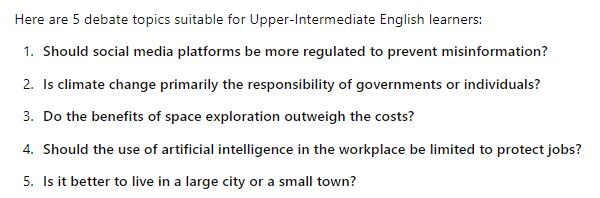
Here are 5 debate topics suitable for Upper-Intermediate English learners:
- Should social media platforms be more regulated to prevent misinformation?
- Is climate change primarily the responsibility of governments or individuals?
- Do the benefits of space exploration outweigh the costs?
- Should the use of artificial intelligence in the workplace be limited to protect jobs?
- Is it better to live in a large city or a small town?
The list would be displayed on the board at the front, and students could work in pairs or small groups to discuss a question of their choice.
Let’s now move on to a more structured task now. Let`s assume students have been working on a specific topic. As an example, I am going to use coursebook material from Achievers C1 (you can download a free sample from Richmond Publishing here). The unit title is “The Secret of My Success”. Students are presented with the following task:
10. Work in pairs. Debate the statement. Follow the instructions.
Setting a world record is the best measure of success that life can offer.
Student A: Speak in favour of the statement.
Student B: Speak against the statement.
Both speakers can make two statements in response to what the other has said.
And this is my personal ChatGPT-assisted plan:
I would allot some time for students to work individually, in pairs, or in small groups to think of expressions to use that they have been exposed to, as well as to come up with possible arguments for and against the topic. Then we would have a brainstorming session with the students’ notes before the debate.
Next, I would write this prompt: “I want to hold this debate with my upper- intermediate students of English: Setting a world record is the best measure of success that life can offer. Can you provide a table with 5 arguments in one column, 5 counterarguments in the second column and better counterarguments in the third column?”
Here’s the table:
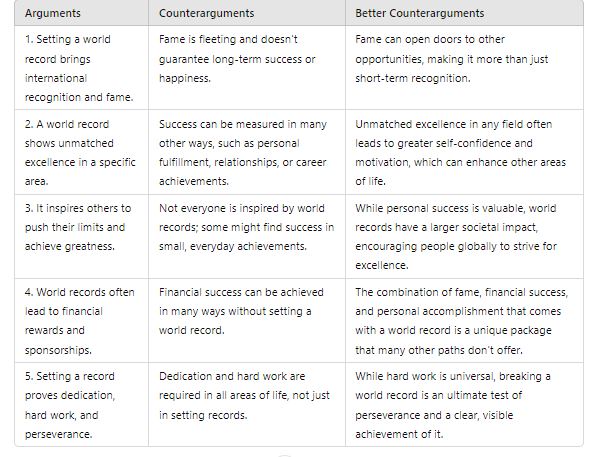
I would display this table on the board at the front and ask the students to, in pairs or small groups, discuss the different arguments, counterarguments and better counterarguments in their own words, while also trying to provide examples from personal experience or from cases they may know. This is how things could unfold from now on:
Student A: Breaking a world record can bring you widespread recognition and fame. You may have struggled at school, but you might excel in swimming and, as a result, become an inspirational figure for many young people.
Student B: Of course, but there will come a time when you are too old for top-level competition. What will you do then? There are many cases of top sports people who fall into depression when they are no longer part of the rat race. Some even turn to drugs and ruin their lives. I can’t think of any specific examples right now, but I know this is not uncommon at all.
Student A again or Student C: I know what you mean. Your sports career may be over in your mid-thirties or so, but you can still enjoy swimming and free yourself from the stress and demands of a professional swimming career. You could become a swimming coach, a sports commentator, or invest the money you’ve earned in a lucrative business.
Here’s an amazing variation of this ChatGPT-assisted activity, assuming students are allowed to use mobile devices in class. It requires the ChatGPT app or similar, like Luzia, installed on the devices along with earphones. We would ask our students to engage in the activity individually through voice chat. Alternatively, we could install a Chrome extension for ChatGPT, such as “Voice Control for ChatGPT”, and invite students to come to the front where the class computer is and hold their arguments and counterarguments in spoken form.
 AI in ELT